The cyberattacks hitting small businesses this year don’t look quite like the ones from even two or three years ago. The broken-English phishing email with obvious red flags is increasingly rare — it’s been replaced by AI-written messages that read like they came from a real colleague, and in some cases, by phone calls and video calls using a cloned voice or face of someone the victim actually trusts.
The fundamentals haven’t disappeared — ransomware, phishing, and stolen passwords are still the backbone of most attacks. What’s changed is how convincing and automated those attacks have become. Here’s what’s actually hitting small businesses right now, and what to do about each one.
What Are the Most Common Cyberattacks Targeting Small Businesses in 2026?
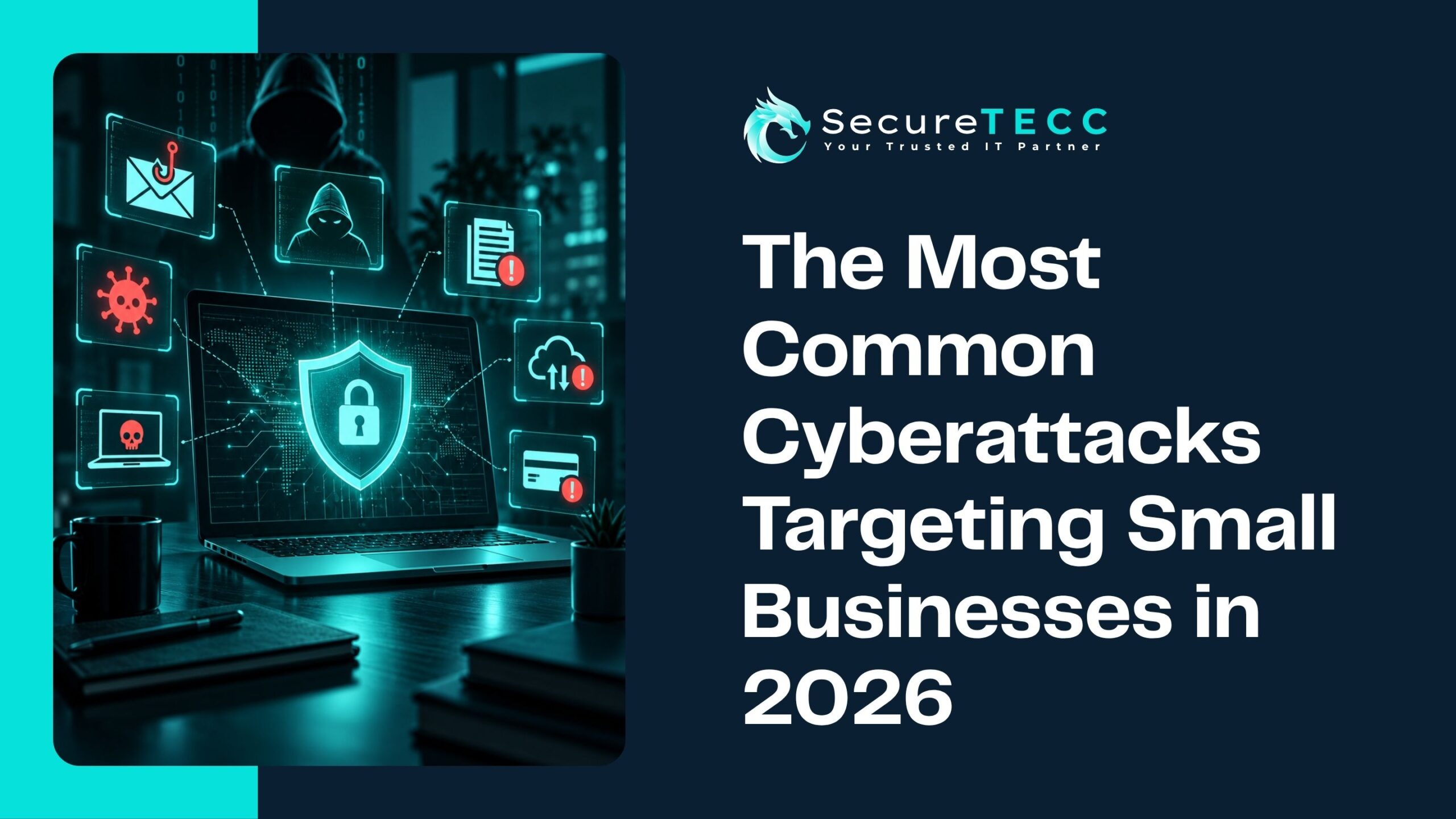
The attacks most likely to hit a small business this year are phishing (increasingly AI-generated and harder to spot), ransomware, credential stuffing using stolen or reused passwords, breaches that arrive through a vendor or software partner rather than directly, and a fast-growing category of AI voice-cloning and deepfake scams impersonating executives or IT staff. Most of these succeed through a person, not a technical flaw.
1. Phishing — Now Often Written by AI
Phishing remains the most common way attackers get in, but the emails themselves have changed. AI tools now let attackers generate polished, personalized messages referencing real details about a business — far more convincing than the generic scams of a few years ago, and considerably harder for an employee to catch just by looking for typos or awkward phrasing.
2. Ransomware
Ransomware locks down files and systems until a ransom is paid, and it remains one of the most disruptive attacks a small business can face — not because of the ransom itself, but because of the operational shutdown while systems are locked. Businesses without properly tested, offline backups are the ones who end up facing the hardest choice between paying and rebuilding from scratch.
3. AI Voice Cloning and Deepfake Scams
This is the category that’s genuinely new to the threat landscape, and it’s growing fast. Attackers can now clone a real person’s voice from just a few seconds of audio — pulled from a voicemail greeting, a podcast, or a video posted online — and use it to impersonate an executive, IT staff member, or vendor on a phone call. The FBI’s 2025 Internet Crime Report specifically flagged AI voice-cloning fraud as a top emerging threat, and the World Economic Forum’s 2026 Global Cybersecurity Outlook found that 73% of organizations were directly affected by cyber-enabled fraud in the past year.
The pattern usually involves urgency: a cloned “CEO” voice calling a finance employee asking for an urgent wire transfer, or a fake “IT support” call asking someone to read back a multi-factor authentication code during a supposedly scheduled password reset. The fix isn’t detecting the fake voice in the moment — it’s having a policy that any unusual financial request or credential request gets verified through a separate, known channel before anyone acts on it.
4. Credential Stuffing and Reused Passwords
When a password leaks in a breach of one, completely unrelated service, attackers automatically try that same email-and-password combination across other sites and business accounts — betting, correctly, that a lot of people reuse passwords. This remains one of the simplest and most common ways into a business account, and it doesn’t require tricking anyone into clicking a link.
5. Breaches That Arrive Through a Vendor, Not You
Increasingly, small businesses get exposed not through their own mistake, but through a software vendor, IT platform, or business partner they rely on. A breach at a shared tool — a case management platform, a payment processor, an industry-specific software vendor — can expose your data even if your own systems were never directly touched. This makes vendor security part of your own risk, whether you control it directly or not.
What Do All of These Attacks Have in Common?
Despite the growing sophistication of the tools involved, the underlying pattern hasn’t really changed: most successful attacks exploit either a person (through convincing social engineering) or a gap that was left open (an unpatched system, a reused password, an unmonitored account). AI has made the social engineering piece more convincing, but it hasn’t replaced the basic playbook — it’s sharpened it.
What Can a Small Business Actually Do About All of This?
None of these threats require an enterprise-level security budget to meaningfully defend against:
- Multi-factor authentication on every account that supports it — the single most effective defense against credential-based attacks
- A verification policy for unusual requests — any urgent financial or credential request gets confirmed through a separate, known channel before anyone acts, regardless of how convincing the voice or email sounds
- Tested, offline or separately stored backups — so a ransomware incident is a recoverable inconvenience, not an existential threat
- Regular software and firmware updates — closing the known gaps attackers rely on most
- Ongoing employee awareness — since the threats keep evolving, a single training session years ago isn’t enough anymore
What Might This Look Like for a Real Business?
Picture an accounts payable clerk at a mid-sized business getting a call that sounds exactly like the company’s CFO — same voice, same speech patterns — urgently requesting a wire transfer before a “closing” that afternoon, with instructions not to loop in anyone else first. Without a verification policy, that urgency alone is often enough to get the transfer sent. With a simple rule in place — any wire request over a certain amount gets confirmed by calling the requester back on their known number, not the one just used — the same call becomes a five-minute delay instead of a six-figure loss.
How SecureTECC Approaches This
SecureTECC’s Cybersecurity services are built around defending against this exact mix of old and new threats — layered protection, real-time monitoring, and the kind of practical policies (like request verification and MFA rollout) that stop an attack before the technology even becomes the deciding factor.
Frequently Asked Questions
Are small businesses really targeted by AI voice-cloning scams, or is that just a large-company problem?
Small businesses are increasingly targeted specifically because they’re less likely to have verification policies in place, and the tools needed to clone a voice have become cheap and accessible — this is no longer limited to sophisticated, well-funded attackers.
How much audio does someone need to clone a voice convincingly?
Modern AI voice cloning tools can produce a convincing result from just a few seconds of audio — a voicemail greeting, a video posted online, or a recorded call is often enough.
Is antivirus software enough to protect against these threats?
No — antivirus addresses malicious software on a device, but it doesn’t stop social engineering, a stolen password being reused, or a convincing phone call asking someone to wire money. Real protection requires layered defenses and, just as importantly, verification habits.
What’s the single easiest thing a small business can do right now?
Set a simple internal rule: any unusual financial request or credential request — regardless of how it arrives or how convincing it sounds — gets verified through a separate, known contact method before anyone acts on it.
Do these AI-driven attacks mean traditional threats like phishing and ransomware matter less now?
Not at all — they remain the most common attack types overall. AI has made some of them more convincing, but hasn’t replaced the fundamentals, which is why basic protections like MFA, backups, and patching still matter as much as ever.
The Bottom Line
The tools attackers use keep getting more sophisticated, but the fundamentals of defense haven’t changed nearly as much as the headlines suggest. Multi-factor authentication, tested backups, updated software, and a habit of verifying unusual requests still stop the overwhelming majority of what’s actually hitting small businesses this year.
Not sure how well your current defenses hold up against these evolving threats? Book a free consultation with SecureTECC Solutions and we’ll take an honest look together — no pressure, no obligation.