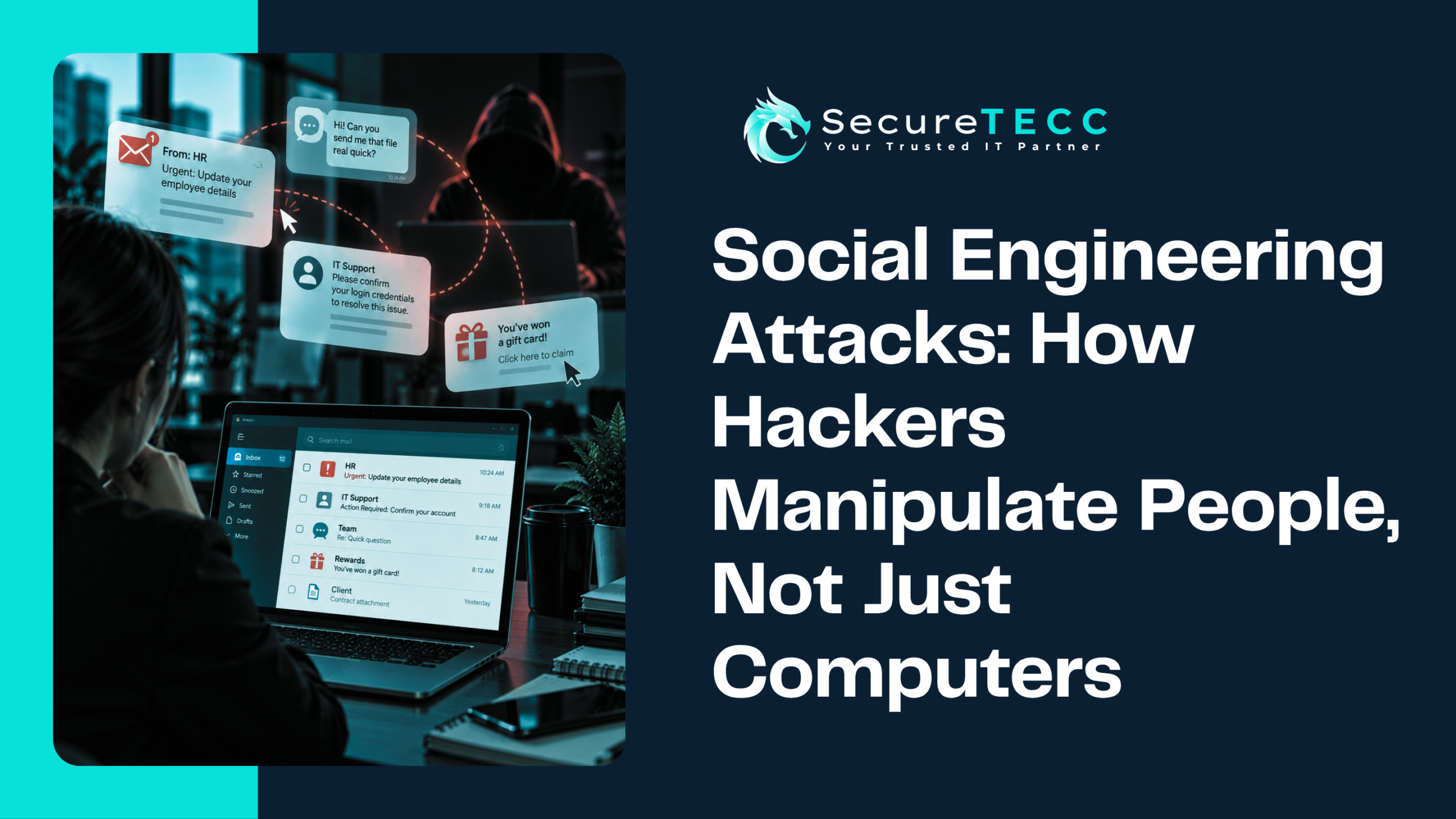
A man in a delivery uniform, hands full of boxes, waits by a locked office door until someone walking in holds it open for him. A phone call comes in from “IT,” asking an employee to confirm their login details to fix an urgent system issue. Neither of these involves a single line of malicious code — and both are genuinely effective ways into a business.
Social engineering is the umbrella term for this entire category of attack: manipulating people rather than exploiting software. Most cybersecurity conversations default straight to email phishing, but that’s really just one tactic within a much broader playbook — one that increasingly includes phone calls, text messages, and even walking straight through the front door. Here’s the fuller picture, and what actually defends against it.
What Is Social Engineering, and How Is It Different From Hacking?
Social engineering is the use of psychological manipulation — trust, urgency, authority, curiosity — to trick a person into giving up information or access, rather than exploiting a technical flaw in software. It includes email phishing, but also phone-based scams, physical tactics like tailgating into a secure building, and digital tricks like fake USB drives or impersonated vendor requests. The common thread is a person being deceived, not a system being hacked.
Why Has Social Engineering Moved Beyond Email?
Email phishing still matters, but it’s no longer the whole story. Verizon’s 2026 Data Breach Investigations Report found that 41% of social engineering breaches now involve vectors other than email — phone calls, text messages, and social media among them — and that mobile-centric social engineering, including voice calls and texts, succeeds roughly 40% more often than traditional email phishing. Attackers are diversifying specifically because years of email-focused training have made inboxes a somewhat harder target than they used to be.
What Are the Main Types of Social Engineering Attacks?
Beyond standard email phishing, a handful of tactics show up consistently:
Vishing and Smishing (Phone and Text-Based Scams)
Vishing (voice phishing) and smishing (SMS phishing) move the same manipulation tactics from email into a phone call or text message — often impersonating a bank, IT support, or an executive, and relying on the added pressure of a live, real-time conversation to push someone into acting quickly.
Pretexting
Pretexting involves an attacker inventing a believable scenario — a “pretext” — to gain trust before making a request. A common example: someone calling and claiming to be from IT, walking an employee through a fake “password reset” that actually hands their real credentials to the attacker.
Baiting
Baiting dangles something tempting — a free download, a “lost” USB drive left in a parking lot, a too-good-to-be-true offer — designed to get someone to open it and unknowingly install malware in the process.
Quid Pro Quo
Similar to baiting, but framed as an even exchange: an attacker offers something that looks like a helpful service — “free” IT support, a prize, a software upgrade — in return for information or access.
Tailgating and Piggybacking
This is social engineering’s physical form: an unauthorized person follows an employee through a secured door, often posing as a delivery driver, a new hire who “forgot their badge,” or simply someone carrying enough boxes that holding the door feels like basic courtesy.
What Psychological Principles Do These Attacks Actually Exploit?
Despite the variety of tactics, most social engineering attacks lean on the same small set of psychological levers:
- Authority — people are conditioned to comply quickly with someone who appears to be in a position of authority, like IT, a vendor, or an executive
- Urgency — a manufactured time pressure that discourages pausing to verify before acting
- Reciprocity — the subtle social pull to return a favor, which is exactly what makes quid pro quo and “helpful stranger” tactics work
- Social proof and familiarity — a request that looks like it’s coming from someone or something already trusted is far less likely to be questioned
None of this requires sophisticated technology. It requires understanding how people naturally respond to authority, urgency, and trust — and building a scenario around exploiting exactly that.
Why Is Physical Social Engineering Often Overlooked?
Most businesses put real effort into digital security — firewalls, email filtering, antivirus — while treating a locked office door as “handled” simply because it’s locked. But a locked door only works if people actually use it correctly, and holding a door open for someone carrying boxes is an act of basic politeness, not a security failure in most people’s minds. That’s exactly the gap tailgating is designed to exploit: it doesn’t look suspicious, because it’s built entirely around normal, polite human behavior.
What Might This Look Like for a Real Business?
Picture an attacker combining two tactics in sequence: first, a phone call to the front desk posing as a vendor technician scheduled for a “routine equipment check,” building just enough credibility and familiarity. A day later, that same person shows up in person, is recognized by name from the earlier call, and is waved into a secure area without anyone double-checking their identification. Neither step involved hacking anything — just a believable scenario and a request that felt consistent with what staff already expected.
How Do You Actually Defend Against Social Engineering?
Because social engineering targets people rather than systems, the most effective defenses are habits and policies, not just software:
- A verification culture — any unusual request for credentials, access, or money gets confirmed through a separate, known channel before anyone acts, regardless of how legitimate the request sounds
- Clear physical security policies — visitor badges, sign-in logs, and a workplace norm where asking “can I see your ID” isn’t considered rude
- Training that covers more than email — phone scams, physical tailgating, and in-person pretexting deserve the same attention as phishing, especially given how much ground these non-email tactics have gained
- Technical backstops — multi-factor authentication and access controls that limit the damage even when a social engineering attempt succeeds
How SecureTECC Approaches This
SecureTECC’s Cybersecurity services and employee awareness support are built around this full picture — not just email-focused phishing training, but the broader reality that attackers now move between phone, email, and in-person tactics depending on what’s easiest. Layered protection, including MFA and access controls, ensures a single successful social engineering attempt doesn’t automatically become a full breach.
Frequently Asked Questions
Is social engineering the same thing as phishing?
Phishing is one specific tactic within the broader category of social engineering — social engineering also includes phone-based scams, physical tailgating, pretexting, and baiting, all of which manipulate people rather than exploiting software.
Why would an attacker bother with something like tailgating instead of just hacking remotely?
Physical access can bypass digital security entirely — plugging a device directly into a network, accessing unlocked workstations, or stealing physical documents — and businesses often invest far less in defending against it than they do against digital threats.
How can employees tell the difference between a legitimate vendor and a pretexting attempt?
A consistent verification habit helps more than trying to “spot” a scam in the moment — confirming any unscheduled or unusual visit or request through a known contact at the actual vendor, rather than relying on how convincing someone sounds or looks.
Is it rude to ask someone for ID or question why they’re in a secure area?
It shouldn’t be treated that way — a workplace culture that normalizes checking credentials, even for someone who seems legitimate, is one of the most effective and low-cost defenses against physical social engineering.
Do small businesses really need to worry about social engineering this broadly?
Yes — these tactics don’t require large, well-funded attackers, and small businesses are frequently targeted precisely because they’re less likely to have formal verification habits or physical security policies in place.
The Bottom Line
Social engineering has always been about manipulating people, and that playbook has only gotten broader — moving well beyond the inbox into phone calls, in-person visits, and anywhere else trust can be exploited. The most effective defense isn’t a single tool; it’s a habit of verification that holds up regardless of which channel an attacker chooses.
Want an honest look at how your team and physical workplace would actually hold up against these tactics? Book a free consultation with SecureTECC Solutions — no pressure, no obligation.