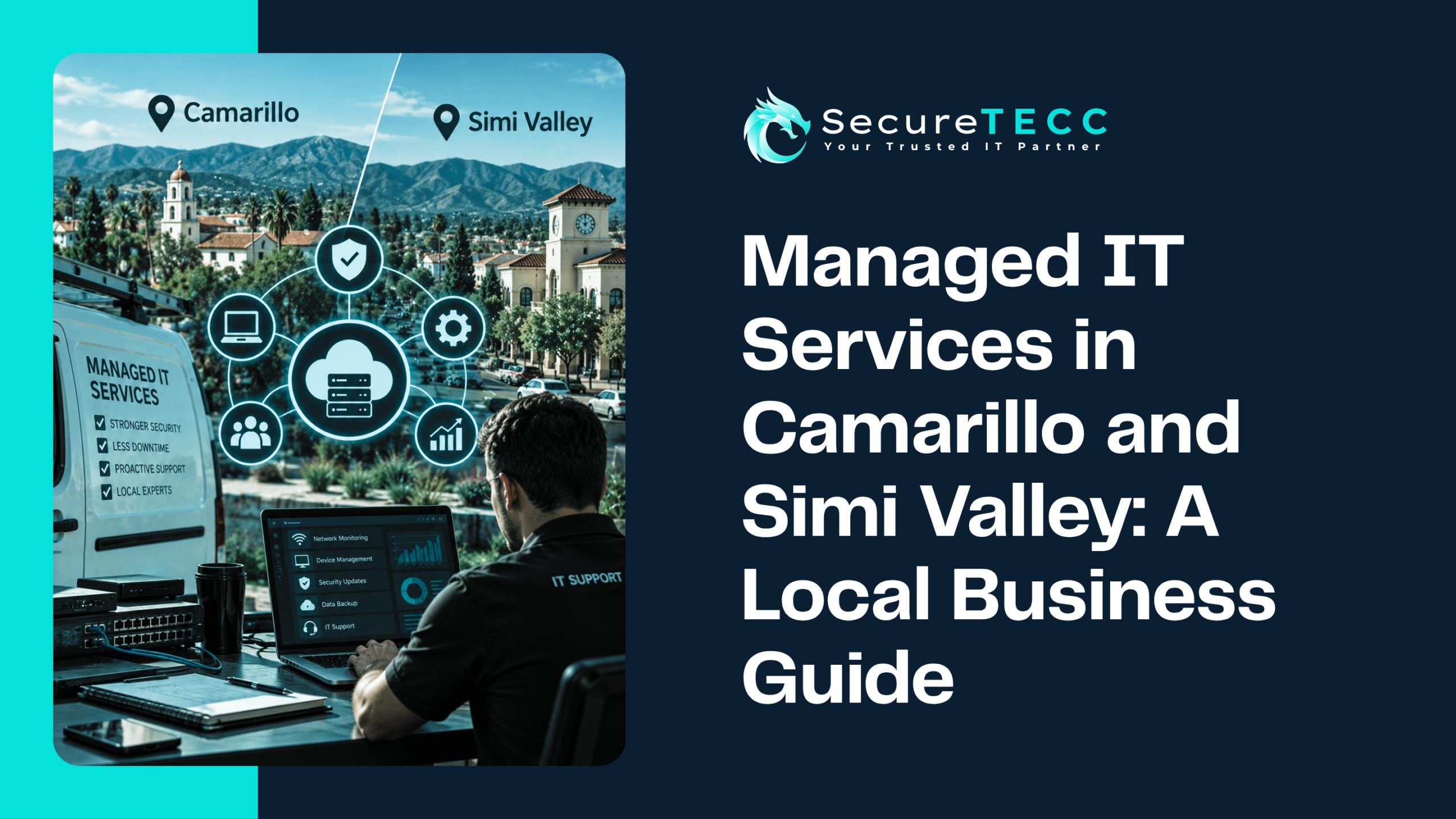
Camarillo and Simi Valley sit on opposite sides of the same stretch of Ventura County, connected by the 101 and 118 corridors and the business community that moves between them. It’s common for a company to have staff, vendors, or clients in both — an ag-tech distributor in Camarillo working with a Simi Valley manufacturer, or a Simi Valley aerospace supplier with an office closer to the 101. Despite that overlap, the two cities actually run on noticeably different business bases, and that difference matters more for IT decisions than it might seem.
This isn’t a generic “managed IT is good for you” overview — it’s a look at what actually differs between these two markets, and what a business in either one (or both) should actually be thinking about.
What’s the Connection Between Camarillo and Simi Valley for Local Businesses?
Camarillo and Simi Valley are both Ventura County business hubs connected by the 101 and 118 corridors, with Thousand Oaks sitting roughly between them. Many businesses operate across both — staff commuting between locations, vendor relationships crossing city lines — which makes a single IT provider who genuinely covers both areas a practical advantage rather than a convenience.
What Makes Camarillo’s Business Mix Distinct?
Camarillo’s economy leans heavily on agriculture, technology, and manufacturing — a mix that brings its own IT priorities: point-of-sale and inventory systems for ag-adjacent retail and distribution, reliable connectivity for tech and manufacturing operations, and the everyday proactive support that keeps a growing business from losing time to preventable technical issues.
What Makes Simi Valley’s Business Mix Distinct?
Simi Valley’s economy centers more heavily on aerospace and defense, healthcare and biotechnology, and precision manufacturing — a genuinely different risk and compliance profile than Camarillo’s. Businesses here are more likely to be working as a defense contractor or subcontractor, handling sensitive data tied to government or aerospace work, which raises the bar for what “good enough” IT security actually looks like.
Why Does This Difference Actually Matter for IT Decisions?
This is where the two cities genuinely diverge. A Simi Valley manufacturer working anywhere in the defense supply chain is increasingly affected by the Cybersecurity Maturity Model Certification (CMMC) — a Department of Defense security framework that’s actively rolling out, with Phase 1 self-assessment and scoring requirements already in effect, and third-party certification requirements for more sensitive contracts beginning in Phase 2 in late 2026. Even businesses not directly required to certify are increasingly asked by prime contractors and partners to demonstrate solid underlying security practices as a condition of doing business.
Camarillo businesses face real cybersecurity risk too, of course — but without that same defense-contract compliance pressure layered on top for most. The practical result: a Simi Valley manufacturer’s IT conversation often needs to start with “what does our security posture actually need to demonstrate,” while a Camarillo business’s conversation more often starts with “how do we stop losing time to preventable IT problems.”
What Should a Business in Either City Actually Look For?
Regardless of which market you’re in, a few fundamentals apply to both:
- A provider who can actually get to you — on-site response matters for hardware issues and network setups, and that means a provider genuinely based nearby, not routing a technician in from much farther away
- Proactive monitoring, not just reactive support — catching problems before they become downtime, rather than waiting for a ticket
- Security that matches your actual exposure — a defense-adjacent Simi Valley manufacturer and a Camarillo retail distributor don’t need identical security setups, and a provider should be able to explain why, specifically for your business
- Backup and recovery sized to what you’d actually lose — whether that’s client records, inventory data, or controlled technical information tied to a defense contract
What Might This Look Like in Practice?
A Camarillo-based ag distribution company dealing with recurring point-of-sale slowdowns during peak season needs a provider who can diagnose and fix network bottlenecks fast, with proactive monitoring catching the next slowdown before it hits during a busy week. A Simi Valley precision manufacturer supplying parts into the defense industry has a different, higher-stakes problem: documenting and maintaining security controls well enough to satisfy a prime contractor’s supplier questionnaire, not just keeping the network running smoothly. Both are legitimate “managed IT” needs — they just point toward different priorities.
How Does SecureTECC Serve Both Markets?
SecureTECC Solutions is based in Thousand Oaks, putting us within easy reach of both Camarillo and Simi Valley — not routing support from somewhere farther down the coast. We offer the same core services across both markets — Managed IT, Cybersecurity, Network Design & Administration, and Backup & Data Recovery — scaled to what each business actually needs, whether that’s day-to-day proactive support for a growing Camarillo business or stronger underlying security practices for a Simi Valley manufacturer navigating increasing defense-industry expectations.
Frequently Asked Questions
Does my Simi Valley business need to worry about CMMC if we’re not a direct defense contractor?
Possibly — CMMC requirements are increasingly flowing down through the defense supply chain, meaning subcontractors and even some vendors to prime contractors can be affected. It’s worth checking directly with any defense-industry partners about what they’re expecting from you.
Is managed IT pricing different between Camarillo and Simi Valley?
Pricing is typically driven by business size, systems, and scope of support needed rather than which city you’re in — what differs more is what that support needs to actually cover, given each area’s different business and compliance landscape.
Can one IT provider realistically support a business with locations in both cities?
Yes, especially a provider genuinely based nearby — the 101/118 corridor connecting Camarillo and Simi Valley is a reasonable service radius for a Ventura County-based provider to cover both locations without routing support from far outside the area.
What’s the biggest IT mistake businesses in this area tend to make?
Treating IT support as generic rather than matched to actual risk — a defense-adjacent Simi Valley manufacturer and a Camarillo retail business genuinely need different things, and a one-size-fits-all approach tends to either overspend on unnecessary coverage or underprotect where it actually matters.
How do I know if my current IT provider actually understands our industry’s specific needs?
Ask directly — a provider who can speak specifically to what your industry and location actually require, rather than offering the same generic pitch they’d give any business, is a good sign they’ve actually thought about your situation rather than applying a template.
The Bottom Line
Camarillo and Simi Valley share a corridor and plenty of overlapping business relationships, but they run on genuinely different economic bases — and that difference should shape how each business approaches its IT and security setup, not just who provides it. The right partner understands both markets well enough to know the difference.
Curious what managed IT built around your specific business — wherever it falls on that corridor — actually looks like? Book a free consultation with SecureTECC Solutions — no pressure, no obligation.