Oxnard’s economy doesn’t look like a typical Southern California tech hub, and that’s exactly the point. It’s a city built on agriculture, food processing, manufacturing, and the logistics network feeding into the Port of Hueneme — businesses that run on shipping schedules, harvest timing, and supply chains, not just office email. That mix makes Oxnard’s business community genuinely different from its neighbors, and it also means the cybersecurity risks businesses here actually face look a little different too.
Attackers don’t care whether a business processes strawberries or spreadsheets — they care whether it’s an easy target. For Oxnard’s agricultural operations, manufacturers, distributors, and the professional and healthcare businesses that support them, that risk is climbing fast. Here’s what’s actually driving it, and what real protection looks like.
Why Are Oxnard Businesses Increasingly a Target?
Small and mid-sized businesses across the country are being targeted at a growing rate, and Oxnard is no exception. Verizon’s 2025 Data Breach Investigations Report found that small and mid-sized businesses experience confirmed breaches at roughly four times the rate of large organizations, and ransomware was involved in 88% of small business breaches — more than double the rate seen at large companies. Attackers increasingly favor smaller businesses precisely because their defenses tend to be thinner than what a large enterprise can afford.
What Makes Oxnard’s Business Mix Particularly Exposed?
Oxnard’s economic base brings its own specific set of vulnerabilities that don’t always show up in generic cybersecurity advice written for office-based businesses:
- Operational and supply chain systems — agricultural and manufacturing operations increasingly rely on connected equipment, inventory systems, and shipping/logistics software tied to the port and national distribution networks, each one a potential entry point
- Seasonal and shift-based workforces — agricultural and food processing operations often bring on seasonal staff and shared devices, which can make consistent access controls harder to maintain than in a stable, year-round office environment
- Point-of-sale and payment systems — retail, hospitality, and food service businesses handling customer payment data are a consistent target for attackers specifically hunting for financial information
- Vendor and partner connections — businesses tied into a wider supply chain (growers, processors, distributors, shipping partners) inherit some risk from every partner they connect systems with
What Are the Most Common Threats Hitting Local Businesses Right Now?
A few patterns show up consistently across small and mid-sized businesses in this region:
- Phishing and business email compromise — fraudulent emails designed to trick staff into wiring money, sharing credentials, or clicking a malicious link
- Ransomware — malicious software that locks down systems and files until a ransom is paid, capable of halting operations entirely for a business that depends on daily shipping or processing schedules
- Compromised vendor or partner accounts — attacks that arrive through a trusted business relationship rather than directly
- Outdated or unpatched systems — older software and equipment, common in manufacturing and operational environments, that no longer receives security updates
What Does “Cybersecurity Services” Actually Include?
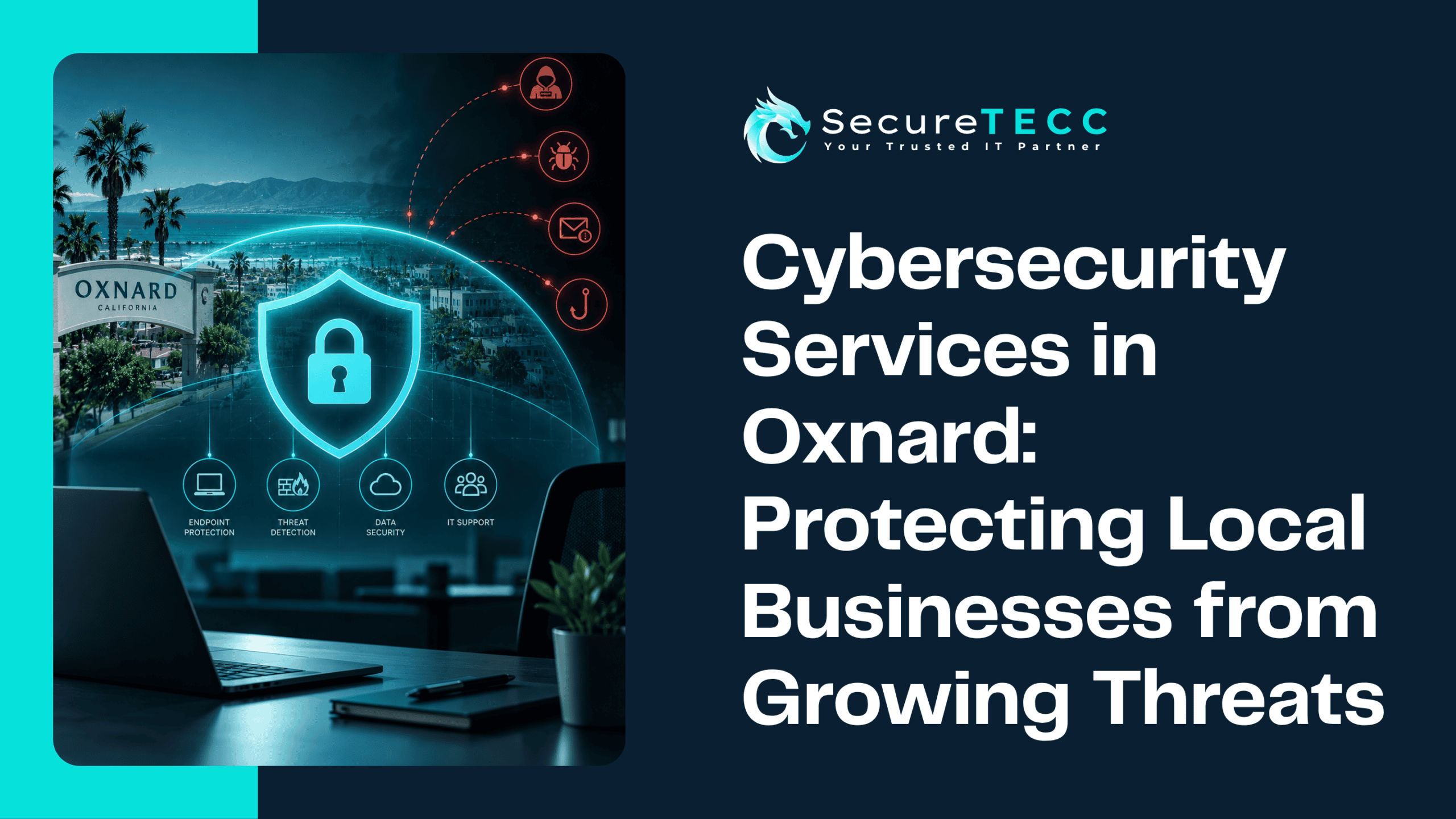
The term gets used loosely, so it’s worth being specific about what real protection generally covers:
- Firewalls and network security — controlling and monitoring what traffic moves in and out of your network
- Real-time threat monitoring and response — actively watching for suspicious activity rather than discovering a problem after the fact
- Endpoint protection — securing individual devices, from office computers to warehouse and operational equipment
- Backup and disaster recovery — so a ransomware incident or system failure doesn’t mean permanently losing operational or financial data
- Employee awareness and training — since most breaches still start with a person clicking something they shouldn’t, not a sophisticated technical exploit
- Compliance support — helping meet the security expectations increasingly built into vendor agreements, insurance policies, and industry regulations
What Happens When a Local Business Actually Gets Hit?
Picture a mid-sized food distribution company coordinating shipments in and out of the Port of Hueneme on a tight seasonal schedule. A ransomware attack locks down their order management system during peak harvest season — no shipping confirmations, no inventory visibility, no way to coordinate with growers or carriers. Every day that system stays down isn’t just a technical problem; it’s product that can’t move and relationships with partners who needed reliable timing. A business with proper backups and a tested recovery plan is back up within a day or two. One without it can be down for weeks, with real product loss on top of the technical recovery.
How Should a Local Business Actually Get Started?
Rather than trying to fix everything at once, a reasonable starting point looks like:
- Get an honest assessment — understand what’s actually protecting your systems today versus what you assume is in place
- Prioritize based on real exposure — payment systems, operational technology, and financial data usually deserve attention before less critical systems
- Close the most common gaps first — outdated software, missing backups, and untrained staff are consistently where breaches start
- Build toward ongoing monitoring — rather than a one-time fix, since threats and your business both keep changing
How SecureTECC Approaches This for Oxnard Businesses
SecureTECC provides layered Cybersecurity Services — including real-time threat monitoring, firewalls, and Backup & Data Recovery — designed around how a business actually operates, not a generic office template. For Oxnard’s agricultural, manufacturing, and logistics-adjacent businesses, that means understanding the operational and supply chain systems involved, not just the email inbox.
Frequently Asked Questions
Do agricultural and manufacturing businesses really need the same cybersecurity as an office-based company?
The specifics differ — operational technology and supply chain systems bring different risks than a typical office network — but the underlying need for monitoring, backups, and access controls applies just as much, and in some ways more, given how disruptive downtime can be during a harvest or shipping schedule.
How much does cybersecurity typically cost for a small or mid-sized Oxnard business?
It varies significantly based on business size, systems, and current gaps, which is why starting with an assessment matters — it lets you prioritize based on actual risk rather than guessing at a generic package.
Is ransomware really likely to target a business our size?
Yes — small and mid-sized businesses are disproportionately targeted specifically because attackers assume, often correctly, that defenses are weaker than at a large enterprise. Size doesn’t provide the protection many business owners assume it does.
What’s the fastest way to reduce risk if we can’t do everything at once?
Start with backups (so an incident doesn’t mean permanent data loss), basic employee training (since phishing remains the most common entry point), and making sure software and systems are current — those three consistently address the most common ways businesses actually get breached.
Does cyber insurance cover the cost if something goes wrong?
It can help offset financial impact, but most policies now require documented security measures to qualify for coverage in the first place — and insurance doesn’t prevent the operational disruption a ransomware incident or breach can cause while you’re recovering.
The Bottom Line
Oxnard’s mix of agriculture, manufacturing, and logistics gives it a business character that’s genuinely different from a typical office-based city — and that means the cybersecurity risks facing local businesses deserve more than a one-size-fits-all approach. Getting real protection in place isn’t about fear; it’s about matching your defenses to how your business actually operates.
Curious where your business’s current setup actually stands? Book a free consultation with SecureTECC Solutions and let’s take an honest look together.