Most businesses in the Conejo Valley don’t have an IT problem — they have an IT strategy problem. Technology gets bought reactively: a server here, a software subscription there, a new tool every time a department asks for one. Years later, you’re paying for overlapping systems, wrestling with tools that don’t talk to each other, and making big decisions without a plan.
That’s the gap IT consulting fills. A good IT consultant — often acting as a virtual CIO — helps you step back, align your technology with your business goals, and build a roadmap that controls costs and supports growth. This article explains how IT consulting works, what a technology roadmap looks like, and when a Thousand Oaks business should bring in outside strategic help.
Why Conejo Valley Businesses Are Investing in IT Strategy
Thousand Oaks and the wider Conejo Valley are home to a concentration of established, growth-minded businesses — professional firms, healthcare practices, and mid-sized companies that have outgrown the seat-of-the-pants technology decisions that worked when they were small. As these businesses scale, the cost of poor technology choices grows with them, and so does the value of getting those choices right.
That’s the shift driving demand for IT consulting locally: business leaders increasingly recognize that technology is no longer a back-office utility but a core driver of productivity, security, and competitive advantage. The companies pulling ahead aren’t necessarily the ones spending the most on IT — they’re the ones spending deliberately, guided by a strategy that ties every technology decision back to a business goal. This guide explains how that strategic layer works and how to put it to work in your business.
What Is IT Consulting (and a vCIO)?
IT consulting is strategic guidance about how your business uses technology — distinct from the day-to-day work of fixing computers and managing networks.
The role of a virtual CIO
A large company employs a Chief Information Officer to set technology strategy. Most Thousand Oaks small and mid-sized businesses can’t justify that salary — but they still need the strategy. A virtual CIO (vCIO) delivers that expertise on a fractional basis: a senior technology advisor who understands your business, sits in on planning, and guides major decisions, without the full-time cost.
Strategy vs. day-to-day support
It helps to separate two things. Support keeps your existing technology running. Consulting decides what technology you should have in the first place — and how it should evolve. The best providers offer both, so your strategy and your support stay aligned instead of pulling in different directions.
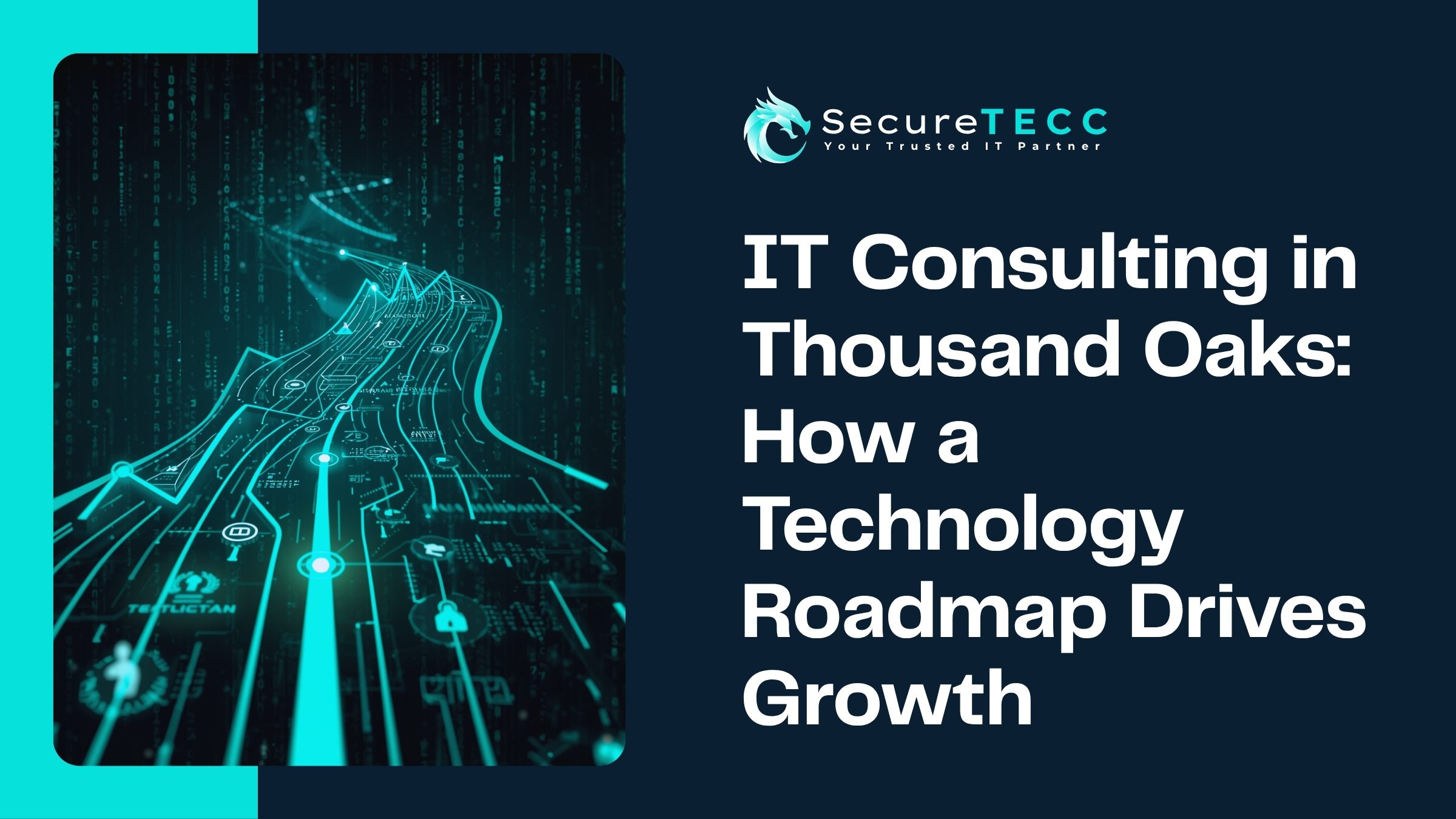
Building a 12-Month Technology Roadmap
A technology roadmap turns scattered IT spending into a deliberate plan.
Auditing your current stack
It starts with an honest inventory: what hardware, software, and services do you have, what do they cost, and what condition are they in? This often surfaces immediate wins — duplicate subscriptions, aging equipment about to fail, or security gaps that have quietly accumulated.
Aligning IT spend to business goals
Next, your consultant connects technology to where the business is heading. Planning to add staff? Open a second location near Westlake Village? Move systems to the cloud? Each goal has technology implications, and the roadmap sequences and budgets them so you’re never blindsided by a surprise expense — or held back by infrastructure that can’t keep up.
IT Consulting Use Cases for Conejo Valley Businesses
Consulting earns its value at specific inflection points.
Planning an office move or expansion
Relocating or opening a new office is one of the riskiest IT moments a business faces. Cabling, internet, phones, network design, and a smooth move with minimal downtime all need planning weeks in advance. A consultant manages this so your team is productive on day one in the new space.
Budgeting for hardware refreshes
Computers and servers don’t last forever, and replacing everything at once is painful. A roadmap spreads hardware refreshes across a planned cycle, smoothing your budget and avoiding the productivity hit of equipment that fails unexpectedly.
Measuring ROI on IT Investments
KPIs that matter
Good IT consulting is accountable. Track metrics like reduced downtime, fewer support tickets, faster onboarding of new employees, and total cost of ownership per user. These numbers turn “we spent money on IT” into “here’s what we got for it.”
Avoiding wasted spend
A surprising amount of IT budget goes to unused licenses, redundant tools, and over-provisioned services. A consultant’s first pass often pays for itself by eliminating spend you didn’t realize you had — money that can be redirected to technology that actually moves the business forward.
When to Bring in an Outside IT Consultant
Growth, mergers, and compliance triggers
If your business is growing fast, has outgrown its current systems, is facing new compliance requirements, or is making a significant technology investment, that’s the moment for strategic guidance. The cost of a wrong decision at these junctures — buying the wrong system, scaling the wrong way — far exceeds the cost of consulting that gets it right.
What a vCIO Engagement Looks Like Month to Month
Businesses sometimes assume IT consulting is a one-time project — a consultant swoops in, delivers a report, and disappears. The most valuable engagements are ongoing, because technology and your business both keep changing.
Regular strategy reviews
In a typical virtual CIO relationship, you meet on a regular cadence — often quarterly — to review how technology is performing against the roadmap, discuss upcoming business changes, and adjust the plan. These reviews keep technology decisions deliberate rather than reactive. When a new tool gets proposed, or a vendor pitches an upgrade, you have a trusted advisor to help you evaluate whether it actually serves your goals.
Budgeting and vendor management
A vCIO also helps you plan and defend your IT budget, so spending is intentional and predictable. They manage relationships with vendors on your behalf — internet providers, software companies, hardware suppliers — so you’re not personally chasing support tickets or negotiating renewals. Over time, this consolidated oversight typically uncovers savings and eliminates the redundant tools and forgotten subscriptions that quietly drain budgets.
Common Technology Mistakes a Consultant Helps You Avoid
Many of the most expensive IT mistakes are strategic, not technical — and they’re exactly what good consulting prevents.
Buying the wrong solution
It’s painfully common for a Conejo Valley business to invest in software or hardware that doesn’t fit, doesn’t integrate with their other systems, or doesn’t scale — and then to be stuck with it for years. A consultant evaluates options against your actual needs before you commit, saving you from costly mismatches.
Scaling without a plan
Growth is good, but unplanned growth creates technology chaos: systems that buckle under load, security gaps that widen as you add staff, and costs that balloon unpredictably. A roadmap ensures your technology grows with you in a controlled, budgeted way.
Neglecting security and continuity
In the rush of running a business, security and disaster preparedness often get deferred — until an incident makes them urgent. A consultant builds these into your roadmap proactively, so you’re protected before something forces the issue rather than after.
Frequently Asked Questions
What does an IT consultant do for a small business? An IT consultant provides strategic guidance: assessing your current technology, aligning it with your business goals, and building a roadmap for what to invest in and when. It’s about making smart technology decisions, not just fixing problems.
How is IT consulting different from managed IT services? Managed IT services handle the ongoing operation and support of your technology. IT consulting is the strategic layer — deciding what technology you need and how it should evolve. Many businesses use both together.
Do you offer vCIO services in Thousand Oaks? Yes. SecureTECC provides virtual CIO services that give Conejo Valley businesses senior technology strategy on a fractional basis, without the cost of a full-time executive.
How much does IT consulting cost? It varies by scope — a one-time roadmap project is priced differently than ongoing vCIO advisory. We’ll scope it to your needs during an initial consultation.
Is IT consulting worth it for a small business? For most growing businesses, yes. The cost of a single wrong technology decision — buying the wrong system, scaling poorly, or overlooking security — typically far exceeds the cost of consulting that prevents it. The value shows up as avoided waste, smoother growth, and spending that’s aligned with your goals. For a Conejo Valley business at a turning point, that guidance often pays for itself many times over in the very first year.
Let’s Build Your Technology Roadmap
Stop buying technology reactively. Book a consultation with SecureTECC and we’ll help you build a clear 12-month technology roadmap that cuts wasted spend, reduces risk, and scales with your Thousand Oaks business. It starts with one conversation about where you want to go.