A ransomware note on a paralegal’s screen an hour before a filing deadline isn’t a hypothetical scenario for law firms anymore — it’s a fast-growing reality. BakerHostetler’s 2026 Data Security Incident Response Report found that ransomware attacks against law firms nearly doubled in 2025 compared to the year before, and legal data has become one of the more valuable targets in cybercrime specifically because of what it contains: privileged communications, financial records, and case details clients trusted their attorneys to protect.
For a law firm, IT isn’t just about keeping computers running. It’s tied directly to a professional and ethical obligation to protect client confidentiality, alongside compliance requirements and deadlines that don’t move just because a system is down. Here’s what actually matters for a law firm’s technology setup, and where the real risk tends to hide.
What Does IT Support Actually Need to Cover for a Law Firm?
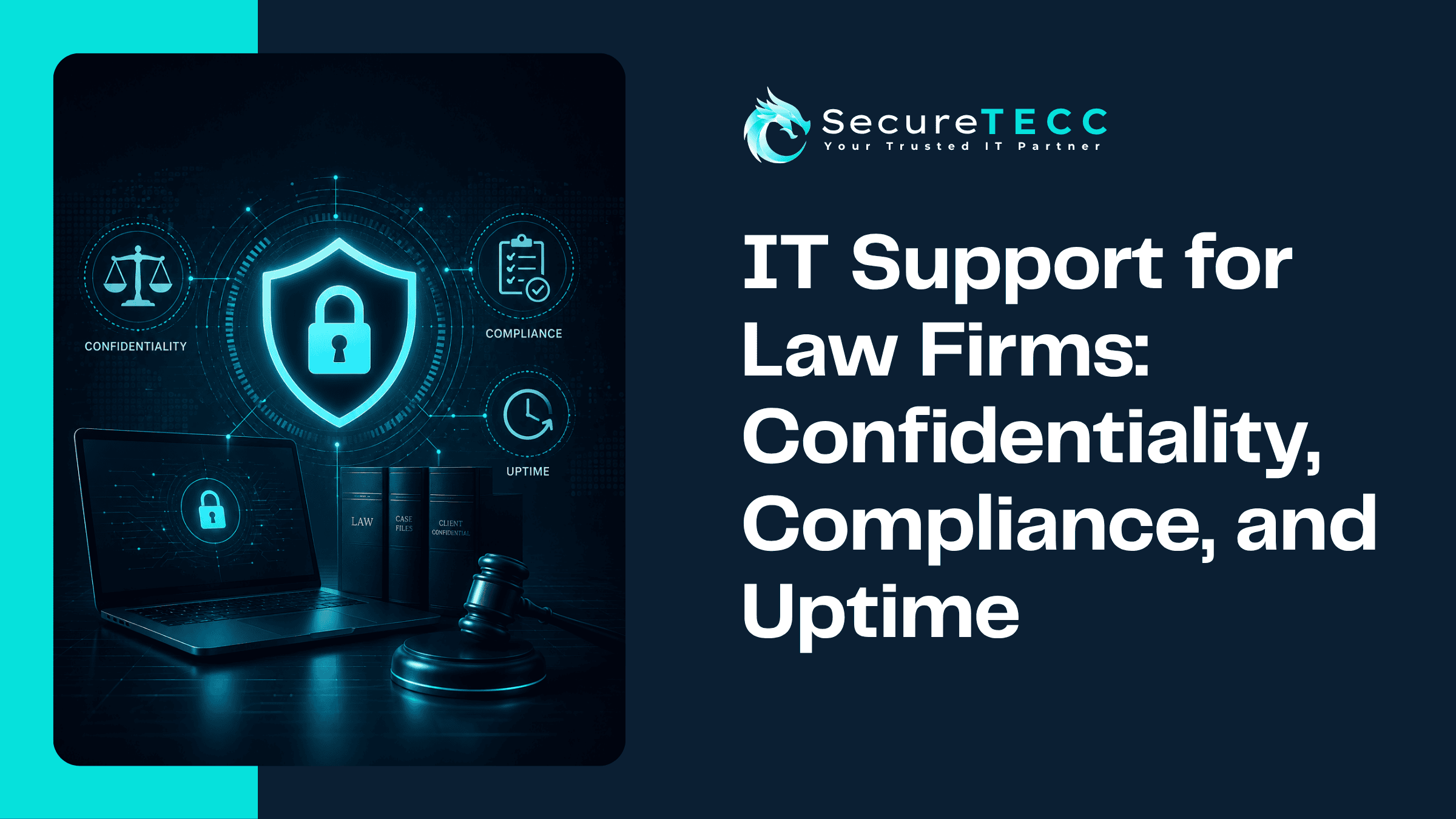
For a law firm, IT support needs to address three things at once: protecting confidential client data from a growing wave of targeted cyberattacks, meeting the compliance and ethical obligations that come with handling privileged information, and keeping systems reliable enough that a technical issue never becomes the reason a filing deadline is missed or a client loses confidence in the firm.
Why Are Law Firms Such an Attractive Target for Cyberattacks?
Law firms sit on an unusually valuable concentration of sensitive information — merger details, litigation strategy, financial records, personal client data — often with fewer dedicated security resources than the industries whose secrets they’re holding. Attackers know this. Recent tracking has identified over 200 ransomware incidents targeting law firms between 2025 and early 2026, and several major legal technology vendors have suffered breaches that exposed records from firms who never directly interacted with the attacker at all.
That last point matters more than it might seem: a firm can do everything right internally and still be exposed through a case management platform, research tool, or document-sharing service it relies on. Vendor security has become part of a firm’s own risk profile, whether or not that firm controls it directly.
What Does “Confidentiality” Actually Require From Your IT Setup?
Attorneys have a professional duty to safeguard client information — most state bar rules mirror the American Bar Association’s Model Rule 1.6, which requires “reasonable efforts” to prevent unauthorized access to or disclosure of client data. In practice, that duty translates into specific technical requirements:
- Access controls — making sure staff can only reach the client files relevant to their role, not the entire firm’s case database
- Encryption — for data both in transit (emails, file transfers) and at rest (stored documents and backups)
- Secure client communication — protected portals or encrypted email rather than sending sensitive documents through unsecured channels
- Audit trails — a record of who accessed what and when, which matters both for security and for demonstrating “reasonable efforts” if a dispute ever arises
What Compliance Requirements Should a Law Firm Actually Worry About?
Beyond bar association ethics rules, several other compliance layers commonly apply depending on a firm’s practice areas: state-level data breach notification laws, client-specific requirements written into engagement agreements (increasingly common with corporate and insurance clients), and — for firms handling trust accounts — the strict recordkeeping and security expectations tied to IOLTA compliance. A firm practicing in areas that touch healthcare, financial services, or government contracts may layer additional regulatory requirements on top of that.
The common thread across all of it: documentation matters as much as the security measures themselves. Being able to show what protections were in place, and when, is often as important as the protections working perfectly.
Why Does Uptime Matter So Much for a Law Firm Specifically?
Downtime costs every business money, but for a law firm it carries a sharper edge: court deadlines don’t extend because a server crashed, and billable hours stop the moment attorneys can’t access case files, email, or research tools. A single afternoon of downtime during discovery, a filing deadline, or a client call isn’t just lost productivity — it can mean a missed deadline with real professional consequences, or a client wondering whether their sensitive matter is in capable hands.
What Happens When a Law Firm’s Systems Go Down at the Wrong Moment?
Picture a small litigation firm the night before a major filing deadline. Their document management system goes down — not from an attack, just an unexpected server failure — and nobody can access the final version of a brief that three attorneys have been revising for days. Without a proper backup and a support team available outside business hours, that’s a genuine crisis: scrambling to reconstruct work from email attachments and local drafts, racing against a deadline that a court isn’t going to move.
A firm with proper backups, redundancy, and 24/7 support available reaches a very different outcome — a stressful hour instead of a professional emergency.
What Should a Law Firm’s IT Setup Actually Include?
Bringing all of this together, a law firm’s technology setup generally needs:
- Layered cybersecurity — firewalls, threat detection, and email security specifically tuned for the phishing and ransomware tactics targeting the legal industry
- Encrypted, tested backups — stored separately from the firm’s primary systems, with recovery actually verified rather than assumed
- Reliable, redundant systems — so a single point of failure doesn’t take down access to case files during a critical window
- 24/7 support availability — because legal deadlines and client emergencies don’t confine themselves to business hours
- Documentation and audit trails — supporting both security and the “reasonable efforts” standard firms are held to
How SecureTECC Approaches This for Legal Clients
SecureTECC works with legal and professional services firms where confidentiality and reliability aren’t optional extras — they’re the baseline. That includes Cybersecurity built around the specific threats targeting legal data, Backup & Data Recovery designed for regulatory-ready storage and audit trails, and Around-the-Clock IT Support so a technical issue at 9 p.m. before a filing deadline gets acknowledged and triaged right away, not left until morning.
Frequently Asked Questions
Do small and solo law practices really need this level of IT support?
Yes — attackers don’t only target large firms, and the same confidentiality and ethical obligations apply regardless of firm size. A smaller practice may need a scaled-down version of these protections, but the underlying requirements don’t disappear because the firm is smaller.
Is cloud-based case management software secure enough for confidential client data?
It can be, provided the platform uses proper encryption and access controls and the firm configures it correctly — but as recent legal-vendor breaches have shown, a firm’s security is only as strong as the weakest platform it relies on, so vetting vendors matters as much as internal security.
What’s considered “reasonable efforts” to protect client data under bar association rules?
This isn’t a single fixed checklist, and expectations continue to evolve, but it generally includes encryption, access controls, staff training, and having an actual incident response plan — not just informal precautions.
How quickly should a law firm be able to recover from a ransomware attack?
With properly tested, offline or immutable backups, many firms can restore critical systems within hours to a day or two, rather than the weeks it can take without a real recovery plan in place — the difference usually comes down to whether backups were actually tested before they were needed.
Does cyber insurance replace the need for strong IT security?
No. Cyber insurance can help offset the financial impact of an incident, but most policies now require documented security measures to even qualify for coverage — and insurance doesn’t prevent the operational disruption, client trust damage, or ethical exposure a breach can cause in the first place.
The Bottom Line
For a law firm, IT support isn’t a background convenience — it’s directly tied to the professional obligations every attorney is already bound by. Getting confidentiality, compliance, and uptime right isn’t about adding complexity to a practice. It’s about making sure the technology underneath it actually holds up to the trust clients are placing in it.
Want a clear-eyed look at where your firm’s current setup actually stands? Book a free consultation with SecureTECC Solutions and we’ll walk through it together — no pressure, no obligation.