Searching “IT support Thousand Oaks” turns up a mix of results that all sound pretty similar — friendly local branding, a Conejo Valley zip code in the footer, promises of a “personal touch.” But a growing number of those “local” companies aren’t quite what they appear to be. Behind the familiar name and area code, some are now regional offices of a much larger, private-equity-owned platform that’s acquired dozens of once-independent IT companies across the country.
That doesn’t automatically make them a bad choice. But it does mean the local-vs-national decision isn’t as simple as reading a company’s homepage. Here’s what actually differs between the two, what to watch for, and what questions get you a straight answer.
What’s the Real Difference Between a Local and National IT Provider?
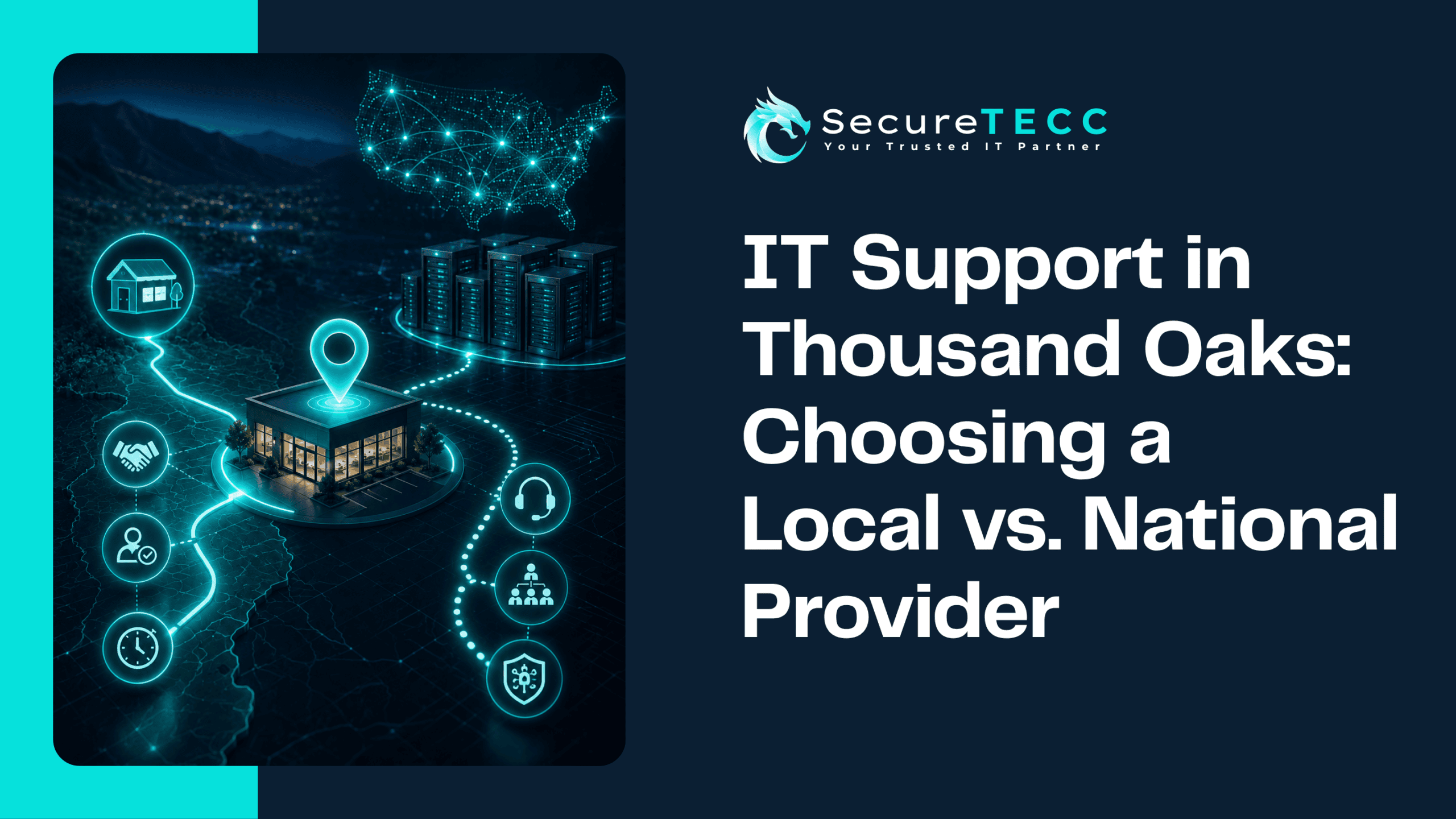
A genuinely local provider is typically owned and operated by people based in your community, with technicians who can be at your office the same day and decisions made by someone who knows your business directly. A national provider operates at a larger scale — often with standardized processes and broader resources — but support may come through a centralized call center, and your account could be one of thousands managed by a distant team.
Does “Local” Always Mean What It Used To?
This is the part worth understanding before you start comparing quotes. The managed IT industry has gone through a major wave of consolidation in the last few years, driven heavily by private equity. Industry research from Omdia found that outside investors — private equity firms or PE-backed platforms — had a role in roughly 80% of managed services provider acquisitions in early 2026, up from about two-thirds of deals just a year earlier.
What this means in practice: a company can look and feel local — same name you’ve always known, same office you’ve driven past — while actually being one branch of a much larger, investor-owned roll-up operating under dozens of regional brands. That’s not necessarily worse, but it’s a different business than the independently owned local shop it may resemble on the surface. It’s worth knowing which one you’re actually evaluating.
What Are the Practical Advantages of a Genuinely Local Provider?
When a provider is truly local — independently owned, physically based nearby — a few things tend to follow naturally:
- Faster on-site response — a technician who’s fifteen minutes away can be there same-day for hardware issues, cabling, or setups that can’t be handled remotely
- Direct accountability — you’re often talking to the same small group of people, sometimes including the owner, rather than working through tiered support queues
- Familiarity with the area — local internet providers, common building/office setups, and even other businesses in the community
- Decisions made close to home — pricing, contract flexibility, and priorities aren’t set by a distant corporate office
Where Do National Providers Actually Have an Edge?
To be fair, scale isn’t purely a downside. Larger providers can sometimes offer broader after-hours coverage across more time zones, more specialized security resources, and established relationships with major software vendors. For a business with multiple locations across different states, a national provider’s standardized systems can genuinely simplify things.
The tradeoff is usually responsiveness and personalization — the same infrastructure that lets a national provider serve thousands of clients can also mean your specific business is a smaller priority within a much bigger queue.
What Should You Actually Ask Before Signing With Anyone?
A few direct questions cut through the branding faster than anything on a company’s homepage:
- “Is your company independently owned, or part of a larger holding group?” — a straightforward question that a genuinely local provider will answer plainly
- “Where is the technician who’d come on-site actually based?” — not the company’s marketing address, the real answer
- “Who do I actually talk to when I call — a dedicated team, or a general queue?” — this reveals a lot about day-to-day experience
- “What’s your realistic on-site response time for our specific location?” — get a concrete answer, not a general promise
- “How long have you served businesses specifically in this area?” — longevity in the community is hard to fake
What Does This Look Like for a Thousand Oaks Business Specifically?
Picture a growing professional services firm in the Conejo Valley comparing a handful of providers online. Two “local-sounding” options turn out to be regional brands under the same national holding company once they start asking questions — meaning a hardware issue might mean waiting for a technician dispatched from outside the area, not down the street. The firm that gets a clear, direct answer about ownership and where their actual support team sits usually has a much better sense of what day-to-day support will really look like.
So Which One Is Actually Right for You?
Neither option is universally correct — it depends on what your business actually needs. If fast on-site response, a direct relationship, and decisions made by people who know your business matter most, a genuinely local, independently owned provider is usually the better fit. If your business operates across multiple states or regions and needs standardized systems at scale, a national provider’s infrastructure may be worth the tradeoff.
SecureTECC Solutions is headquartered in Thousand Oaks, with our team — including our security operations — physically based here, not routed through a distant call center. We’re not going to pretend that’s the right fit for every business, but for a Thousand Oaks company that wants a provider who actually knows the area and can be on-site the same day, it’s worth knowing exactly who you’re talking to.
Frequently Asked Questions
Are national IT providers always more expensive than local ones?
Not necessarily — pricing varies widely on both sides. The bigger difference is usually in how support is delivered day to day, not a consistent gap in cost.
How can I tell if a “local” company is actually part of a larger holding group?
Ask directly, or check whether the company is listed as part of a larger platform’s portfolio of acquired businesses — a quick search of the company name alongside “acquired” or “holding company” often surfaces this if it applies.
Does it matter where an IT provider is based if most support happens remotely?
For day-to-day software and connectivity issues, remote support works fine regardless of location. It matters most for hardware failures, on-site setups, and anything that genuinely requires someone physically present.
Is a newly acquired local IT company still worth hiring?
It can be — some hold onto their original team and local responsiveness even after being acquired. It’s worth asking directly whether your day-to-day support team and response times have changed since the acquisition.
What’s the biggest risk of choosing a provider without asking these questions?
Ending up with support that doesn’t match your expectations — assuming you’re getting a responsive, local relationship and instead getting a general support queue with a real but limited connection to your area.
The Bottom Line
The “local vs. national” decision isn’t really about which logo looks friendlier — it’s about who actually shows up when something breaks, and who’s making decisions about how you’re supported. Asking a few direct questions before you sign tells you more than any homepage will.
Curious what genuinely local, Thousand Oaks-based IT support actually looks like day to day? Book a free consultation with SecureTECC Solutions and see for yourself — no pressure, no obligation.